

Executive Function Homeschool Support for Students Who Struggle to Start
Smart kids can still get stuck at the starting line. That's not a character flaw.
ZEAL offers executive function homeschool support that teaches planning, time management, and follow-through.
Live coaching and body doubling build independence, one real assignment at a time.
When "Just Do It" Doesn't Work
It's 9:00 AM and the plan is simple: finish the history reading, then math. At 11:30 the book is open, the page hasn't changed, and your student is somehow reorganizing their pencil cup.
They're not being defiant. They're not lazy. They're stuck, and they often feel worse about it than you do.
This is what an executive function struggle can look like at home. The good news is that executive function skills can be taught, practiced, and strengthened. That's what executive function homeschool support is designed to do.
What Is Executive Function, and Why Does It Matter in Homeschool?
Executive function is the brain's management system. It's the set of skills that turns "I know what to do" into "I did it."
In a traditional school, a lot of executive function work is done for students. Bells signal transitions, teachers post due dates, and classmates set the pace. Homeschool removes most of that outside scaffolding, which is often why the struggle suddenly feels bigger at home.
The Executive Function Skills Behind Everyday Homeschool Struggles
| Skill | What it looks like at home | What helps |
|---|---|---|
| Task initiation | Can't get started, even on easy work | A tiny, specific first step and someone working alongside |
| Time management | "Five more minutes" turns into an hour | Visible time and planned work blocks |
| Organization | Lost worksheets, a buried laptop charger | One home for school materials, reset weekly |
| Planning and prioritizing | Does the fun subject first, forgets the deadline | A weekly plan made together, then checked |
| Working memory | Forgets step two of the directions | Written steps and checklists |
| Emotional regulation | Small frustrations turn into shutdowns | Naming the feeling, a short reset, then a restart |
| Self-monitoring | Thinks the work is done when it isn't | A quick "done means" checklist before calling it finished |
Signs Your Homeschooler Needs Executive Function Support
Every student has off days. Executive function struggles look more like a pattern. Watch for:
- Assignments that take three times longer than they should
- Frequent "I forgot" or "I didn't know that was due"
- Big gaps between what your student knows and what they turn in
- A strong start to the week that falls apart by Wednesday
- Needing you nearby to get anything done
- Frustration, tears, or shutdowns around starting work
- A student who says "I'm just bad at school" when you know they're bright
If several of these sound familiar, your student isn't failing. Their skills just haven't caught up with their workload yet.
6 Executive Function Strategies You Can Use at Home This Week
You don't need a program to start helping. Try these and notice what works for your student.
- Make the first step tiny. "Do your essay" is a mountain. "Write one sentence about your topic" is a step. Starting is the hardest part, so shrink it.
- Make time visible. Use an analog clock or a visual timer. ADHD brains often don't feel time passing, so let them see it.
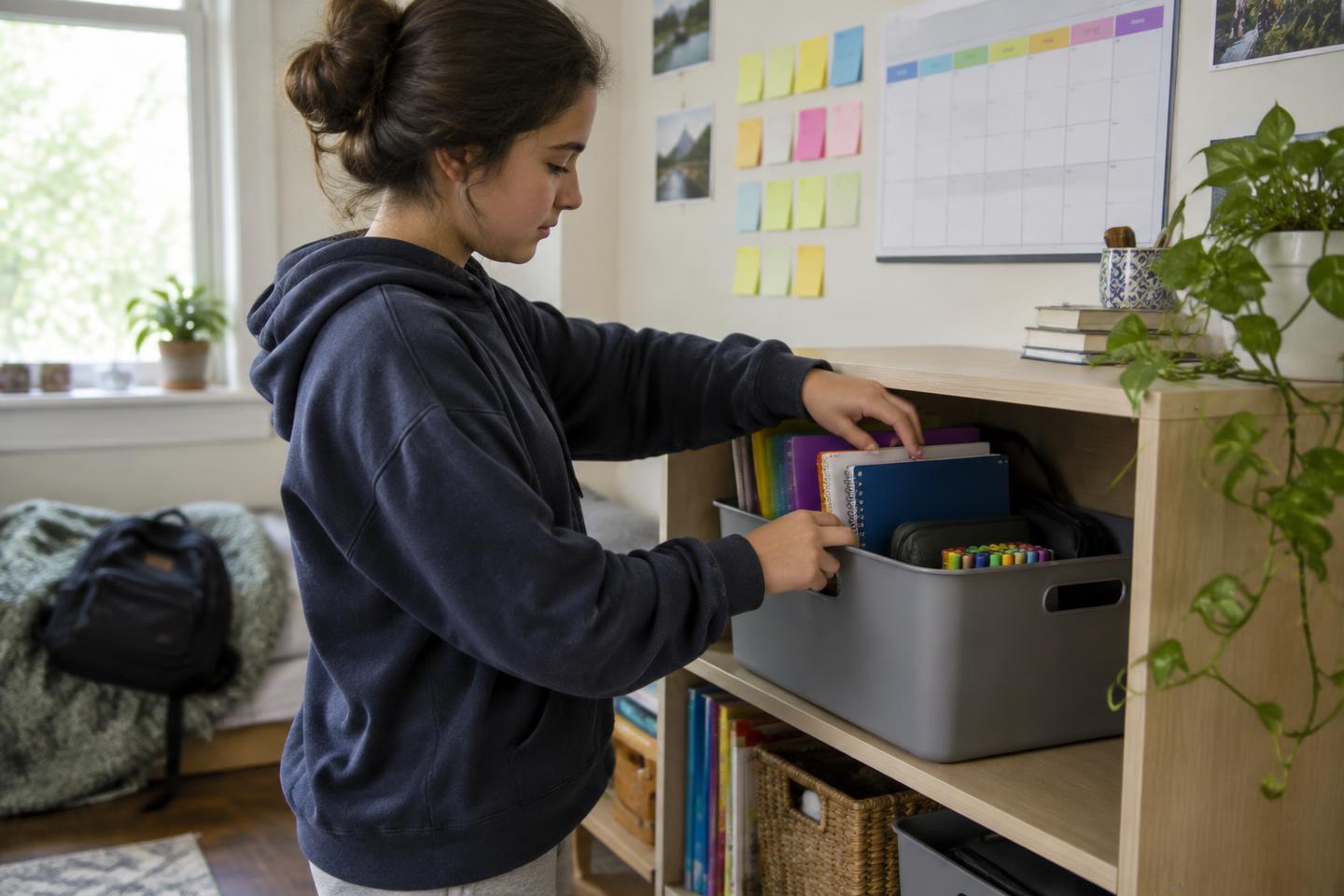
- Give school stuff one home. One bin, one shelf, or one launch pad. When everything has a place, less energy goes into finding things.
- Plan the week, not just the day. A 20-minute Sunday reset to look at what's due helps prevent the Wednesday collapse.
- Work alongside them. This is body doubling. You fold laundry or answer email nearby while they work. Presence helps more than pressure.
- Praise the process. "You started even though it felt hard" builds more than "Good job finishing." You're growing the skill, not just the result.
How ZEAL Provides Executive Function Homeschool Support
Those home strategies help. But many families find they work best with a coach and a community behind them. ZEAL provides both through a simple cycle that repeats every week.
- Learn it. A coach teaches one executive function skill in a way that's interactive, practical, and a little fun.
- Make it personal. Students connect that skill to something real: an assignment, a deadline, a decision, or a goal.
- Use it on real work. During focus time, students work on their own homeschool assignments alongside peers and a coach.
- Reflect. Students name what worked, what didn't, and what they'll try next.
Tuesday Focus Time
Tuesday sessions center on academic focus and executive function practice. Students bring their own work and get it moving with live body doubling and coaching from 1:30 to 3:00 PM ET.
The Sunday Focus Lounge
An optional Sunday session at 7:00 PM ET gives students a calm space to look at the week ahead, plan, and start Monday with a head start instead of a scramble. See how a full session flows on our Curriculum page.

From Support to Independence
The goal of executive function homeschool support isn't to hold your student's hand forever. It's to build skills that eventually run on their own. We think of growth in three stages:
- Supported. A coach and peers provide the structure. Starting happens because someone is there.
- Coached. Students start choosing their own strategies, with a coach asking good questions instead of giving answers.
- Self-led. Students plan their week, start their work, and recover from a hard day on their own.
Every student moves at their own pace. Some move forward quickly in one skill and need more time in another. That's normal, and it's why we coach the individual, not the average.
Why Coaching Works Better Than Reminding
You love your kid. That's exactly why your reminders can land wrong. When a parent says "Have you started yet?" a teen often hears "I don't trust you." When a coach asks "What's your first step?" it lands as a plan.
An outside voice protects your relationship. You get to go back to being the encourager, and your student gets to build skills with someone whose job is to help them figure out how their brain works best.
ZEAL is a program by Carolina ADHD Coaching, so it's designed for brains that think differently. Learn more about our broader approach to ADHD homeschool support, or see what it feels like to belong on The Experience page.
Executive Function Homeschool Support FAQ
Is executive function the same thing as ADHD?
No, but they're closely connected. Most students with ADHD struggle with executive function. Plenty of students without ADHD do too. No diagnosis is required for ZEAL.
Can executive function skills really be taught?
Yes. These skills keep developing through the teen years and into early adulthood, and they can grow with direct teaching, practice, and support.
Will this work with our curriculum?
Yes. Students bring their own assignments to focus time, whatever curriculum, co-op, or online classes you use.
How is this different from tutoring?
Tutoring helps with content in one subject. Executive function coaching works on the skills underneath every subject: starting, planning, managing time, and following through.
What if my student is autistic, gifted, or anxious?
They're welcome. Many students have more than one learning profile. We coach the student in front of us.
How involved do parents need to be?
Very little during sessions. Make sure your student logs in with their assignments ready. We'll handle the coaching.
Give Your Student Executive Function Homeschool Support That Builds Independence
Your student is capable. They just need the skills, the structure, and the right people around them. See how ZEAL helps homeschoolers start, plan, and finish with confidence.
Related Resources

ADHD Homeschool Support That Sees Your Student as an Individual
Why bright homeschoolers with ADHD get stuck, and what real support looks like beyond another curriculum. Outside accountability, executive function coaching, and community, explained.
Read Article
Online Homeschool Enrichment Programs That Build Confidence and Leadership
What to look for in online enrichment, and why live small groups make the difference. Leadership, real-world projects, and life skills teens actually use.
Read Article
Christian ADHD Homeschool Support for the Way God Made Your Student
Faith and ADHD are not in conflict. How grace and structure work together, and how Scripture, character, and executive function skills grow side by side.
Read Article