
The ADHD Homeschool Schedule That Works With Your Teen's Brain
Too rigid and it breaks by Tuesday. Too loose and nothing gets done.
A good ADHD homeschool schedule is a rhythm: predictable anchors, focused blocks, and room to breathe.
Here's a sample day, a weekly plan, and a backup plan for the hard days.
Why Most Homeschool Schedules Fail ADHD Teens
If you've built a beautiful color-coded schedule that lasted three days, you're in good company.
Rigid, minute-by-minute schedules break the first time something runs long, and then the whole day feels ruined. But no schedule at all rarely works either. Many ADHD brains benefit from outside structure to make up for the time awareness and planning that don't come naturally.
The answer is somewhere in the middle: a rhythm, not a rulebook. A good ADHD homeschool schedule has a few fixed anchors, flexible focus blocks, and built-in recovery time.
7 Principles of an ADHD Homeschool Schedule
- Set anchors, not minutes. Keep a few things fixed, like the start time, lunch, and live classes. Let the rest flex.
- Work in focus blocks. Short, focused stretches followed by a break. Blocks of around 25 to 45 minutes are a common starting point, but they're an example, not a rule. Some students do better starting with five or ten minutes and building up from there.
- Put the hardest work in the best window. Find when your teen focuses best and protect that time for the toughest subject.
- Schedule movement. Breaks aren't a reward. They're part of the plan.
- Build in buffer time. Add margin between blocks so one long task doesn't wreck the day.
- Reduce transitions. Every switch costs energy. Group similar tasks and limit subject changes.
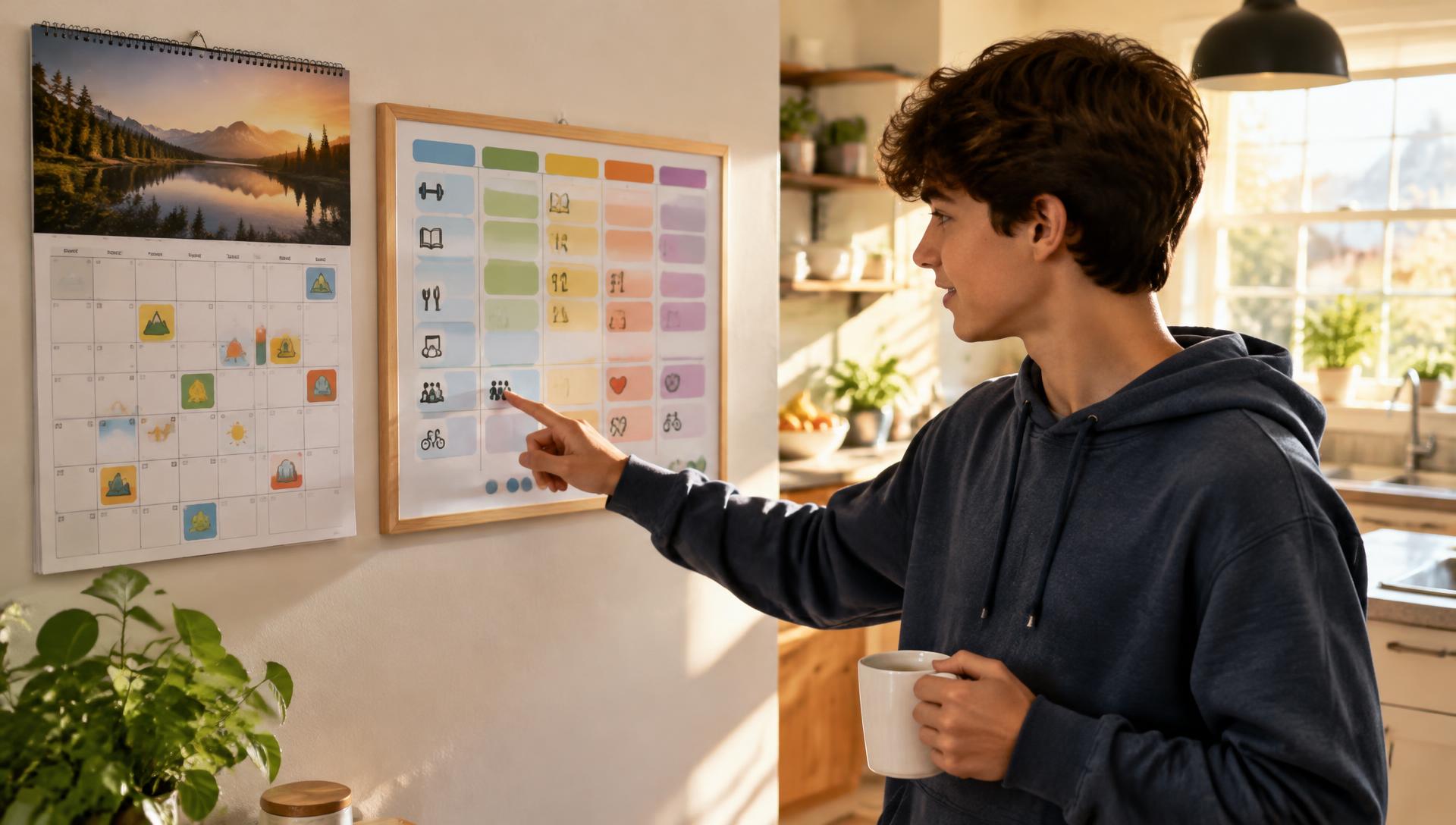
- Make it visible. A schedule in your head doesn't help your teen. Put it on a whiteboard, a printed sheet, or a shared calendar.
A Sample ADHD Homeschool Schedule for Teens
Here's one sample day for a homeschooled teen. Treat it as an illustration, not a template: adjust the times and block lengths to fit your teen, especially if they focus better later in the day or need shorter blocks to start.
| Time | Block | Why it works |
|---|---|---|
| 8:30 to 9:00 | Wake up, breakfast, quick movement | Wakes the body before asking the brain to focus |
| 9:00 to 9:15 | Daily launch: review the plan | A short check-in prevents "What am I doing?" |
| 9:15 to 10:00 | Focus block 1: hardest subject | Tackles the toughest work in a fresh window |
| 10:00 to 10:15 | Movement break | Resets attention before the next block |
| 10:15 to 11:00 | Focus block 2 | Second core subject while energy is still good |
| 11:00 to 11:15 | Snack and reset | Fuel and a mental break |
| 11:15 to 12:00 | Focus block 3: reading or interest-led work | Lower-demand work as energy dips |
| 12:00 to 1:15 | Lunch and free time | Real downtime protects the afternoon |
| 1:30 to 3:00 | ZEAL session (Tue, Thu) or projects and electives | Live structure and accountability twice a week |
| 3:00 to 3:15 | Wrap-up: check off and prep tomorrow | Closes the loop and makes the next day easier |

A Weekly ADHD Homeschool Schedule
A weekly rhythm matters as much as the daily plan. Giving each day a theme reduces decisions and helps your teen know what to expect.
| Day | Focus | Afternoon |
|---|---|---|
| Monday | Core subjects, fresh start | Electives or catch-up |
| Tuesday | Core subjects | ZEAL: skill building and academic focus time, 1:30 to 3:00 PM ET |
| Wednesday | Core subjects, mid-week check-in | Co-op, field trip, or project day |
| Thursday | Core subjects | ZEAL: leadership and real-world projects, 1:30 to 3:00 PM ET |
| Friday | Lighter load, finish and review | Catch-up, creative work, or fun learning |
| Sunday | Rest | Optional ZEAL Focus Lounge at 7:00 PM ET to plan the week |
Block Schedule or Loop Schedule?
Two homeschool scheduling styles often work well with ADHD.
Block Scheduling
Each subject gets a set block on certain days. For example, math every morning and science on Monday, Wednesday, and Friday. This works well for teens who like predictability and knowing exactly what's next.
Loop Scheduling
Instead of assigning subjects to days, you keep a list and work through it in order. Whatever you reach next, you do next. If Tuesday gets cut short, you just pick up where you left off on Wednesday. Nothing is "behind." This works well for teens who get discouraged by a missed day.
Many families combine both: core subjects in fixed blocks, with electives and enrichment on a loop.
The Sunday Reset
One of the most helpful habits in any ADHD homeschool schedule is a short weekly reset. Twenty to thirty minutes on Sunday evening can prevent a lot of Monday chaos.
- Look at what's due this week
- Move unfinished work into the new plan
- Pick the top three priorities
- Clean out the workspace and backpack or bin
- Check the calendar for appointments and activities
ZEAL's optional Sunday Focus Lounge at 7:00 PM ET is designed as a calm, guided space to do exactly this with a coach and peers.

Plan for the Hard Days
Every family has days when the schedule falls apart: illness, a meltdown, a bad night's sleep, or life just happening. Instead of throwing out the whole day, use a minimum viable day.
A minimum viable day is the smallest version of school that still counts. For example:
- One focus block in the most important subject
- A short stretch of reading
- A quick plan for tomorrow
That's it. Your teen still makes progress, still practices showing up, and nobody feels like a failure. Tomorrow you start fresh.
Making an ADHD Homeschool Schedule Stick
- Build it together. Teens are more likely to follow plans they helped create.
- Start simple. Try the anchors first, then add detail.
- Review it weekly. Ask what worked and what didn't, then adjust.
- Add outside accountability. Live classes or a coach give the schedule anchors your teen shows up for.
A schedule is only as strong as the executive function skills behind it. Learn how to support executive function, and see our full guide to homeschooling a teen with ADHD.
ADHD Homeschool Schedule FAQ
How many hours a day should a homeschooled teen with ADHD do school?
It varies by family and state requirements. Focus on focused work, not hours logged. A few strong focus blocks often beat a long day of half-attention.
Should the schedule be the same every day?
Keep the anchors the same, like start time, lunch, and live classes. Let the content of each block vary. Predictable anchors with flexible content is the sweet spot for many families.
What if my teen isn't a morning person?
Shift the schedule. Homeschool lets you put focus blocks in your teen's best window, even if that's afternoon or evening.
How long should focus blocks be?
There's no universal ADHD rule. Blocks of around 25 to 45 minutes with a short break are a common starting point, but some students do better beginning with five or ten minutes and building up. Experiment and adjust as your teen's stamina grows.
How do I get my teen to actually follow the schedule?
Build it together, keep it visible, start with just a few anchors, and add outside accountability like a coach or small-group program.
Add Structure to Your ADHD Homeschool Schedule
ZEAL gives homeschool teens two live anchors a week, plus an optional Sunday reset, with coaching, accountability, and a community that understands how they think.
Related Resources

ADHD Homeschool Support That Sees Your Student as an Individual
Why bright homeschoolers with ADHD get stuck, and what real support looks like beyond another curriculum. Outside accountability, executive function coaching, and community, explained.
Read Article
Homeschooling a Teen with ADHD: What Actually Helps
The teen years change everything. Practical strategies for structure, motivation, big feelings, and high school planning, without losing the relationship.
Read Article
How to Support Executive Function in Teens (Without Becoming the Nag)
Executive function is a whole toolkit. Skill-by-skill strategies and phrases to try for starting, planning, time, organization, and focus.
Read Article